
Dumpster Placement Guide: How to Choose the Right Spot
A good dumpster placement location gives the roll off truck enough room to safely deliver and pick up the dumpster while keeping it close enough to your work area for convenient loading.
Get exact pricing on dumpsters near you.
Key Takeaways
 Plan for at least 60 feet of length, 10.5 feet of width and 25 to 30 feet of vertical clearance.
Choose a flat, paved location that works for both delivery and pickup.
Place the dumpster close to your work area for easier loading, while checking for permits and HOA rules if needed.
What Makes a Good Dumpster Drop-Off Location?
An ideal dumpster drop-off location is stable, accessible and convenient for your project. A driveway is often the easiest option for residential projects, while a jobsite’s designated waste area is typically the best choice for commercial construction and renovation work.
Other locations may work depending on your available space, truck access and local requirements. Before choosing a spot, make sure our driver can deliver and pick up the dumpster safely.
Dumpster Placement Checklist
Before you order, make sure you can answer yes to each of these questions:
☐ Is the drop-off area at least 60 feet long?
☐ Is it at least 10.5 feet wide?
☐ Is there 25 to 30 feet of vertical clearance?
☐ Can the delivery truck reach the location without obstructions?
☐ Is the surface stable and level?
☐ If using an alley or shared accessway, can the truck enter, position the dumpster and leave safely?
☐ Is the driveway free of steep slopes, soft ground and uneven areas?
☐ Is the delivery path clear of utility lines, branches and other overhead obstacles?
☐ Is the delivery path and drop-off area clear of snow and accumulated ice?
☐ Are parked cars and other objects out of the truck's path?
☐ If using a public street, have you confirmed whether you need a dumpster permit?
☐ If you have a homeowners association (HOA), have you confirmed that its rules allow your planned placement?
Winter weather reminder: Clear snow and accumulated ice from the delivery path and drop-off area before your dumpster arrives. See our FAQ on how snow, ice or heavy rain can affect dumpster delivery for more details.
How Much Space Does a Dumpster Need?
PRO TIP
For a typical roll off dumpster delivery, plan for at least:
60 ft
of length
10.5 ft
of width
25–30 ft
of vertical clearance
Account for the Delivery Truck
The roll off truck needs room to approach, position the container and leave, so don't measure only the spot where the dumpster will sit.
Check the entire route for parked cars, fences, gates, buildings, equipment and other obstacles. We'll need the exact same clear route to pick up your dumpster when your project is complete.
Check for Vertical Clearance
A roll off truck lifts and positions the dumpster, so obstacles that look harmless at ground level can still block delivery and pickup.
Check for utility lines, tree branches, low roofs, overhangs, garage structures and anything else hanging over the approach. Look at the entire route, not just the final drop-off spot.
Leave Room to Open the Loading Door
Beyond the container's footprint and truck approach, remember to leave space to open the swinging door. Roll off dumpster doors open outward so you can walk heavy debris directly into the container.
Most roll off dumpsters are about 7.5 feet wide, so the swinging door requires at least 8 feet of clear ground space when it’s open. Make sure walls, vehicles, fencing and equipment aren't blocking this area so you can safely open the door and load your dumpster.
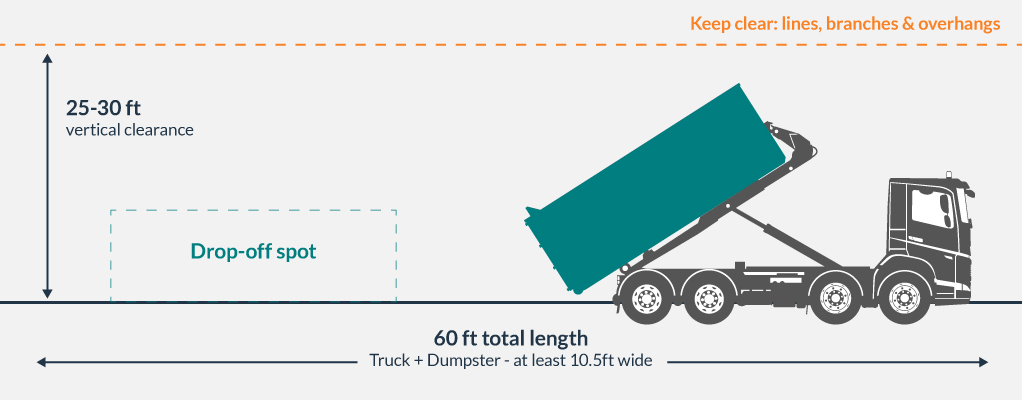
Measure the whole delivery path, not just where the dumpster will sit. Diagram not to scale.
How a Roll Off Dumpster Is Delivered
Where Can You Keep a Dumpster?
The right dumpster location depends on the type of project, available space and how easily the delivery truck can get in and out. When you order, we'll ask for specific placement instructions and use Google Maps and our proprietary OnPoint Placement tool to review and mark your drop-off spot. Since aerial images can be outdated or miss recent changes, sending a photo of the placement location can help us confirm clearance and avoid delivery issues.
Jobsites
For construction, demolition and major renovation projects, a designated waste area within your jobsite is usually the best place for a dumpster.
Choose a spot with enough room for the dumpster and delivery truck, keeping the approach clear of obstacles. Ensure the truck has easy access for empty-and-return service throughout the project. Place the dumpster close enough for efficient loading, but clear of active work areas and equipment hazards.
If space permits, choosing a spot large enough to hold two dumpsters can simplify site logistics. Having extra room gives you flexibility during dumpster exchanges, so you don't have to coordinate removing and replacing a unit at the exact same time or in the exact same spot.
Residential Driveway
A driveway is usually the most convenient location for a residential project when it has enough space and gives the truck a clear path.
Check the driveway's usable length and width, along with its slope and surface. Cracked or weakened pavement, gravel, uneven areas and steep inclines can create delivery problems.
Think about how you'll use the space while the dumpster is there, too.
- Will it block your garage, a side door or a walkway?
- Can vehicles be moved somewhere else?
A single-car driveway may work, but the number of cars the driveway normally holds doesn't tell you whether a dumpster will fit. Measure the usable space and make sure the truck can get in and out.
Streets, Alleys and Shared Accessways
A street, alley, cul-de-sac or shared accessway can work when a driveway or jobsite doesn't, but the truck still needs enough space to enter, position the dumpster and leave.
Check for narrow turns, parked vehicles, gates, overhead obstacles and anything else that could block the truck. If the space isn't solely yours, make sure you have permission to use it and that the dumpster won't prevent neighbors from accessing their property. Public street placement may also require a dumpster permit.
What About Grass or an Unpaved Area?
Grass and other unpaved areas aren't suitable for dumpster placement. The ground needs to support the weight of the dumpster and delivery truck. Soft or wet soil can cause the delivery truck to sink, potentially damaging your property and making it difficult to safely deliver or pick up the dumpster.
If soft ground prevents delivery or traps the dumpster, you could face extra costs:
- Trip fees: Charged if soft ground or obstacles prevent the driver from safely dropping off or picking up the dumpster.
- Extension fees: Daily charges that add up if your dumpster rental pickup is delayed while waiting for ground conditions to dry or clear.
- Tow fees: Applied if a dumpster sinks into mud, grass or snow and requires a tow truck to pull it out before pickup.
PRO TIP
Can a dumpster truck drive over my grass?
Generally, no. Grass and other unpaved areas can become soft or unstable, especially after rain, making it difficult for the delivery truck to safely reach the placement area. A flat, paved surface is preferred for delivery and pickup.
If grass or another unpaved area is your only option, contact our team before ordering. We can help determine whether the location may work for dumpster delivery and placement.
Do You Need Permission for Dumpster Placement?
Your placement location affects whether you need permission from your city or HOA.
Check Whether Your City Requires a Dumpster Permit
Your city may require a dumpster permit for placement on a public street or other right-of-way. Local rules vary, so check with your municipality before delivery if you plan to keep your container in the street.
Check HOA Rules
Some HOA have rules about where you can keep a dumpster and how long it can stay there. Rules may cover:
- Driveway or street placement
- Maximum rental period
- Required approvals
- Restrictions on public or shared areas
These rules can also affect contractors working on residential construction projects. If you're working in an HOA community, check the requirements before scheduling delivery.
What Size Dumpster Fits Your Available Space?
The right dumpster size needs to fit both your project and your property. Use the table below to compare common dumpster sizes, how much space they typically require and where they may fit best.
If you're not sure which size you need, see our Guide to Choosing the Right Dumpster Size before you order.
Dumpster Size & Placement Specs
Dumpster Size | Standard Exterior Dumpster Dimensions | Required Total Delivery Space (Truck + Dumpster) | Driveway & Street Placement Fit | Common Projects |
|---|---|---|---|---|
14' L x 7.5' W x 3.5' H | 60' L x 10.5' W x 25' H | Fits most single-car driveways; minimal street footprint | Small bath remodels, heavy debris (dirt/concrete), garage cleanouts | |
16' L x 7.5' W x 4.5' H | 60' L x 10.5' W x 25' H | Fits most standard residential driveways; takes 1 street parking spot | Small kitchen updates, deck removals | |
22' L x 7.5' W x 4.5' H (Roughly equivalent to the length of a standard passenger minivan) | 60' L x 10.5' W x 25' H | Fits many standard driveways; tight on narrow single-car driveway layouts | Whole-home cleanouts, carpet removal, medium deck tear-offs | |
22' L x 7.5' W x 6' H | 60' L x 10.5' W x 30' H | Similar footprint as a 20 yard; may need more overhead clearance | Major additions, new home construction, commercial cleanouts | |
22' L x 7.5' W x 8' H | 60' L x 10.5' W x 30' H | Same general footprint as a 20 or 30 yard; needs 30 feet of overhead clearance | Commercial demolition, major building construction |
Dumpster Size Visualizer Infographic

What to Do if a Dumpster Won’t Fit
If the dumpster size you need won't fit your available space, you may still have options.
Use Empty-and-Return Service
If a smaller dumpster is the only size that fits your site but you have more debris than it can hold, empty-and-return service lets you keep working without needing a larger container. The full dumpster is picked up, emptied and returned so you can continue loading.
Each empty-and-return counts as a new rental of the same dumpster size at the same location. It costs the same as your initial rental fee, resets both your rental period and tonnage allowance, and will be charged to the card on file.
Rethink the Placement
If the driveway or primary work area won't accommodate the dumpster, look around the property for another location that gives the truck better access and keeps the dumpster close to your project. A side drive, secondary access point or another open area may work better.
For residential projects, moving the dumpster a little farther from the work area may be worth it if it gives the truck a clear path and provides enough room for the container. If a public street is your only workable option, check local permit requirements before scheduling delivery.

Considering a non-standard location because of a steep slope, tight alley, soft ground or overhead obstruction? Contact our team before ordering. We can help you determine whether the location will work and help you avoid potential trip fees from a failed delivery or pickup.
PRO TIP
Once you've chosen and confirmed your dumpster placement location, see our Dumpster Delivery Guide for what to do before the roll off truck arrives.
Dumpster Placement FAQs
How much space do I need for a dumpster?
You’ll need a flat, open space that’s at least 10.5 feet wide and 60 feet long to fit most roll off dumpsters.
- Most driveways can easily fit a 10, 12, 15 or 20 yard roll off dumpster.
- These containers are usually about 7.5 feet wide and anywhere from 14 to 22 feet long, so they tuck into a standard driveway without blocking too much space.
- If your driveway is on the smaller side or your project calls for a larger bin, we can place the dumpster on the street instead, as long as you get any required dumpster permits ahead of time.
How much overhead clearance does a roll off delivery truck need?
A roll off delivery truck needs 25 to 30 feet of vertical clearance to safely lift and slide the dumpster into place. Check for overhead obstacles such as tree branches, power lines and building overhangs around the delivery area.
Will a 20 yard dumpster fit in a standard single-car driveway?
Typically, yes. A 20 yard dumpster is about 22 feet long and 7.5 feet wide, but the driveway's usable dimensions, surrounding obstacles and delivery access all matter. Measure the available space and make sure the truck has a clear path to reach and leave the drop-off location.
Can a dumpster be placed on a steep driveway slope?
No. If your driveway is steep enough that you need to use the parking brake when your vehicle is parked, it's too steep for a dumpster. A level or gently sloped surface is a better choice for safe delivery, placement and pickup.
What’s the best spot for a dumpster on my driveway?
Choose a spot that’s close to your work area but far enough from garage doors or house edges to avoid damage.
- Don’t park the dumpster over cracked pavement or fresh sealcoating; pick the firmest, most level ground you have.
- Position the dumpster so the swinging door faces your work area. This makes it easier to load debris safely and efficiently without reaching over the sides.
Which direction should the dumpster door face when placed near a garage?
The dumpster door should face an accessible area where you can safely load debris. Leave enough room to open the door and use the surrounding space without blocking your garage, walkway, doors or other access points.
What happens if it snows or rains heavily before my dumpster delivery?
Heavy rain or snow can change the condition of a location that was previously suitable. Snow, ice and standing water can make dumpster placement difficult or unsafe. Keep the access route and drop-off area as clear as possible, including any necessary snow and ice removal before the truck arrives. If severe weather significantly changes the condition of the location, contact us before delivery.
Can a dumpster go in an alley?
It can, depending on the alley's width, truck access, overhead clearance and local rules. Make sure the truck can enter, position the dumpster and leave safely without blocking neighboring properties or access.
Can I put a dumpster on the street?
Street placement is often possible, but you’ll likely need to get a dumpster permit before delivery. Check with your city before scheduling street placement.
More Dumpster Rental Resources
Choose the Right Dumpster Size
Compare dumpster sizes to find the right capacity for your debris and project needs.
Prepare for Dumpster Delivery
Learn what to expect on delivery day and how to prepare your site for your dumpster.
Learn How Dumpster Rentals Work
Explore dumpster rental basics, from choosing a size to delivery and pickup.