
How Cubic Yards Help You Plan Your Cleanup
Cubic yards measure how much space your debris takes up. They’re the standard way to size roll off dumpsters and estimate how much material you have to toss. With our guidance, it's easy to calculate your debris in cubic yards and choose the right dumpster rental.
Check available dumpsters near you.

The Basics of Cubic Yards
Cubic yards (yd³) help determine which dumpster size fits your project best. Whether you’re a homeowner clearing out your garage or a contractor managing a remodel, take a minute to familiarize yourself with cubic yards. Understanding them makes estimating your debris simple and helps you avoid overage fees.
What Is a Cubic Yard?
A cubic yard is a unit of volume that’s 3 feet wide, 3 feet long and 3 feet tall (or 1 yard on each side).
A single cubic yard is about the same size as a washing machine.


What Does 1 Cubic Yard Look Like?
It can be tricky to visualize cubic yards. Here are a few comparisons to give you a better sense of their size:
- 1 cubic yard = 3 standard trash cans
- 1 cubic yard = 1 standard washing machine
- 3 cubic yards ≈ 1 pickup truck bed
Why Cubic Yards Matter When You Rent a Dumpster
Each dumpster size has a specific capacity for debris. A 10 yard dumpster can hold up to 10 cubic yards of material while a 20 yard dumpster has space for 20 cubic yards. A key part of planning your dumpster rental is to measure your waste in cubic yards. With an estimate on hand, you can then:
- Match your project to the right size bin
- Stay within the dumpster's fill line
- Prevent overage fees or pickup delays

How Do You Calculate Cubic Yards?
Converting a pile of debris into cubic yards isn't as complicated as it seems. Just distribute your debris evenly in a rectangular shape, then follow the steps outlined in the video and listed below.
1. Take Your Measurements
Measure the length, width and height of your debris pile in feet. When in doubt, it's better to round up slightly.
2. Calculate Volume in Cubic Feet
Multiply those three measurements to find cubic feet.
3. Convert to Cubic Yards
Divide your total by the conversion factor of 27 and you have your estimate in cubic yards.
Example Calculation
If your debris pile is 12 feet long, 6 feet wide and 4 feet high, the calculation process will look like this:
(12 × 6 × 4) ÷ 27 = 10.7 cubic yards
To ensure you have enough space for 10.7 cubic yards of debris, we would recommend you round up to a 12 yard dumpster.
Use these equivalents to understand how much debris each dumpster size holds:
Dumpster Size | 33-Gallon Trash Bags | Wheelbarrow Loads | Pickup Truck Loads |
|---|---|---|---|
50–70 | 80–100 | 3 | |
65–85 | 98–118 | 3–4 | |
80–100 | 125–145 | 4–5 | |
110–130 | 170–190 | 6 | |
170–190 | 260–280 | 9 | |
230–250 | 350–370 | 12 |
How Much Does 1 Cubic Yard Weigh?
Before you make a final decision on your dumpster, remember that not all materials weigh the same. A cubic yard’s weight depends entirely on the debris type. Some materials are light but sizable, while others are dense and heavy.
Because every material has a different density, two debris piles can appear to be the same size but have completely different weights. Use our weight calculators to estimate your material’s total tonnage and stay within your weight limit.
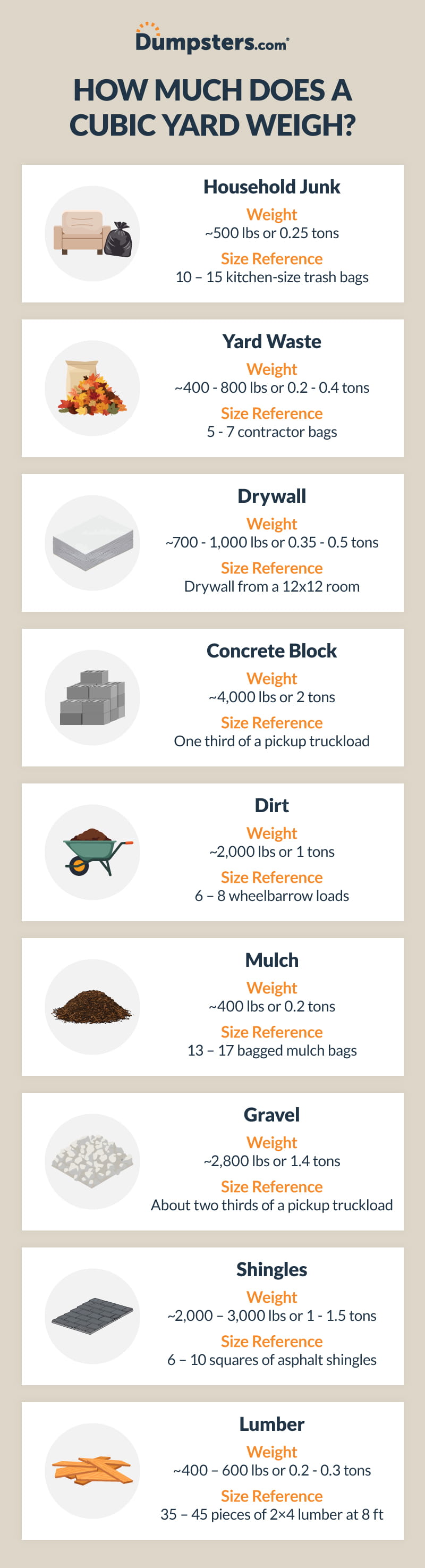
Here’s what a single cubic yard typically weighs for common bulk material types:
Material Type | Weight in Pounds | Weight in Tons |
|---|---|---|
1 cubic yard of mulch | ~400 lbs | 0.2 tons |
1 cubic yard of yard waste | ~400–800 lbs | 0.2–0.4 tons |
1 cubic yard of household junk | ~500 lbs | 0.25 tons |
1 cubic yard of drywall | ~700–1,000 lbs | 0.35–0.5 tons |
1 cubic yard of dirt | ~2,000 lbs | 1 ton |
1 cubic yard of gravel | ~2,800 lbs | 1.4 tons |
1 cubic yard of concrete | ~4,000 lbs | 2 tons |
View Cubic Yard Weights Infographic
Cubic Yard FAQs
Are cubic yards the same as yards?
No, a yard and a cubic yard are not the same thing. A yard measures 3 feet of distance, while one cubic yard equals a three-dimensional space that is 3 feet long, 3 feet wide and 3 feet high. Dumpster sizes are measured in cubic yards because they describe how much debris the container can hold.
Is a cubic yard a measure of volume or weight?
A cubic yard is a measure of volume, not weight. Cubic yardage indicates how much space material takes up, which is why it's helpful for describing a roll off dumpster's capacity.
What are common mistakes in calculating cubic yards?
Common pitfalls are using the wrong units or forgetting to convert cubic feet to cubic yards. It's also difficult to measure irregular piles accurately, especially with loose debris like branches or furniture. Another error to watch out for is rounding down instead of up and choosing a dumpster capacity that’s too small for your job.
How many cubic feet are in a cubic yard?
There are 27 cubic feet in 1 cubic yard, since each yard equals 3 feet.
How do I convert square feet to cubic yards?
Multiply your area’s square footage by its depth in feet, then divide by 27 to get cubic yards.
How do I calculate cubic yards of concrete, dirt or mulch?
Spread your debris as evenly as possible in a rectangle and plug the dimensions into this equation:
Cubic Yards = (Length × Width × Height) ÷ 27
How can I convert the volume of my debris (in cubic yards) into an estimated weight (in tons)?
Start by finding the cubic yardage of your debris. Then look up the average weight per cubic yards of your material type, and plug those two values into this equation:
(Debris in cubic yards x average weight per cubic yards) ÷ 2,000 = debris weight in tons
For example:
(5 cubic yards of household waste x 500 lbs per cubic yard) ÷ 2,000 = 1.25 tons
Weight varies widely depending on debris type. While 5 cubic yards of household waste weigh about 1.25 tons, 5 cubic yards of concrete weigh around 10 tons. Using average weights gives you a reliable material estimation so you're not in the dark as you choose a dumpster size.
How does the type of debris affect the cubic yard capacity I need?
Heavy materials like concrete or dirt add up fast and should always go in a 10 yard dumpster. This is because heavy debris can push you over your weight limit before physically filling the dumpster. Light debris, like drywall or household debris, takes up space but doesn't weigh down your load as much. When in doubt, reach out to our team of experts. We'll help you choose a bin for your project type.
Should I account for material expansion when calculating cubic yards?
Yes, materials like branches or loose yard debris don’t pack tightly. Add 10% to 20% to your total for air space and uneven piles.
Next Steps in Planning Your Cleanup
Dumpster Size Guide
See our containers side by side and find the one that suits your project.
Dumpster Rental 101
Review the dumpster rental process so you know what to expect.
Weight Calculators
Find the calculator for your material type and get a quick estimate.