
How to Load a Dumpster: Your Guide for Safe Loading & Cost Savings
Loading your dumpster the right way can maximize space, prevent overage fees and ensure safe waste disposal. Use these proper loading techniques to keep your project organized, efficient and cost-conscious.
Get exact pricing on dumpsters near you.

How to Load a Dumpster Efficiently
Whether you’re loading construction debris or working on a residential project, follow these simple steps to load your bin safely, efficiently and without going over your dumpster weight limit.
Step-by-Step Proper Loading Techniques for Roll Off Dumpsters
1. Open and secure the dumpster door
Ensure the dumpster door is fully open and locked in place before loading. This provides safe, easy access for large or heavy items.
2. Start with flat, heavy materials
Lay flat, dense items — like drywall, wood or concrete — at the bottom. This creates a stable base and helps distribute weight evenly.
3. Build layers strategically
Stack materials in organized layers, keeping heavier debris on the bottom and lighter waste on top to prevent shifting during pickup.
4. Fill gaps with smaller items
Use small or irregularly shaped pieces to fill empty spaces between larger items. This helps you maximize space and avoid air pockets.
5. Maintain a level load
Keep debris below the fill line and ensure it’s level across the top. You may face extra fees or pickup delays if you overfill your dumpster.
Staying Safe While Loading Your Dumpster
While cost considerations are important when loading your dumpster, safety is key. Follow our tips to keep you and your loading crew safe.
5 Simple Safety Tips for DIY Loading
1. Always lock your dumpster door, whether open or closed
When loading, thread the chain through the slot on the side of the dumpster to hold the door open. This prevents the heavy door from swinging unexpectedly and causing injury. When you're finished working for the day, close the door using the large metal latch and secure it with the pin or clip. Then feed the attached chain through the slot near the latch for extra security.
2. Wear personal protective equipment
Heavy debris can crush your feet, and rough or jagged materials can cut your hands. Steel-toed boots, safety glasses and durable gloves offer the best protection.
3. Watch out for sharp objects and heavy items
Nails, broken glass and metal edges can cause serious injuries. Handle these items with care and keep your hands and body clear when lifting or stacking.
4. Use proper lifting techniques
Always bend at your knees, not your back, when lifting heavy items. Keep the load close to your body, and ask for help with anything too heavy to lift safely on your own.
5. Be careful around the dumpster opening
Avoid leaning into the dumpster or standing on the edges. Debris can shift suddenly, and uneven surfaces around the dumpster can cause trips or falls.
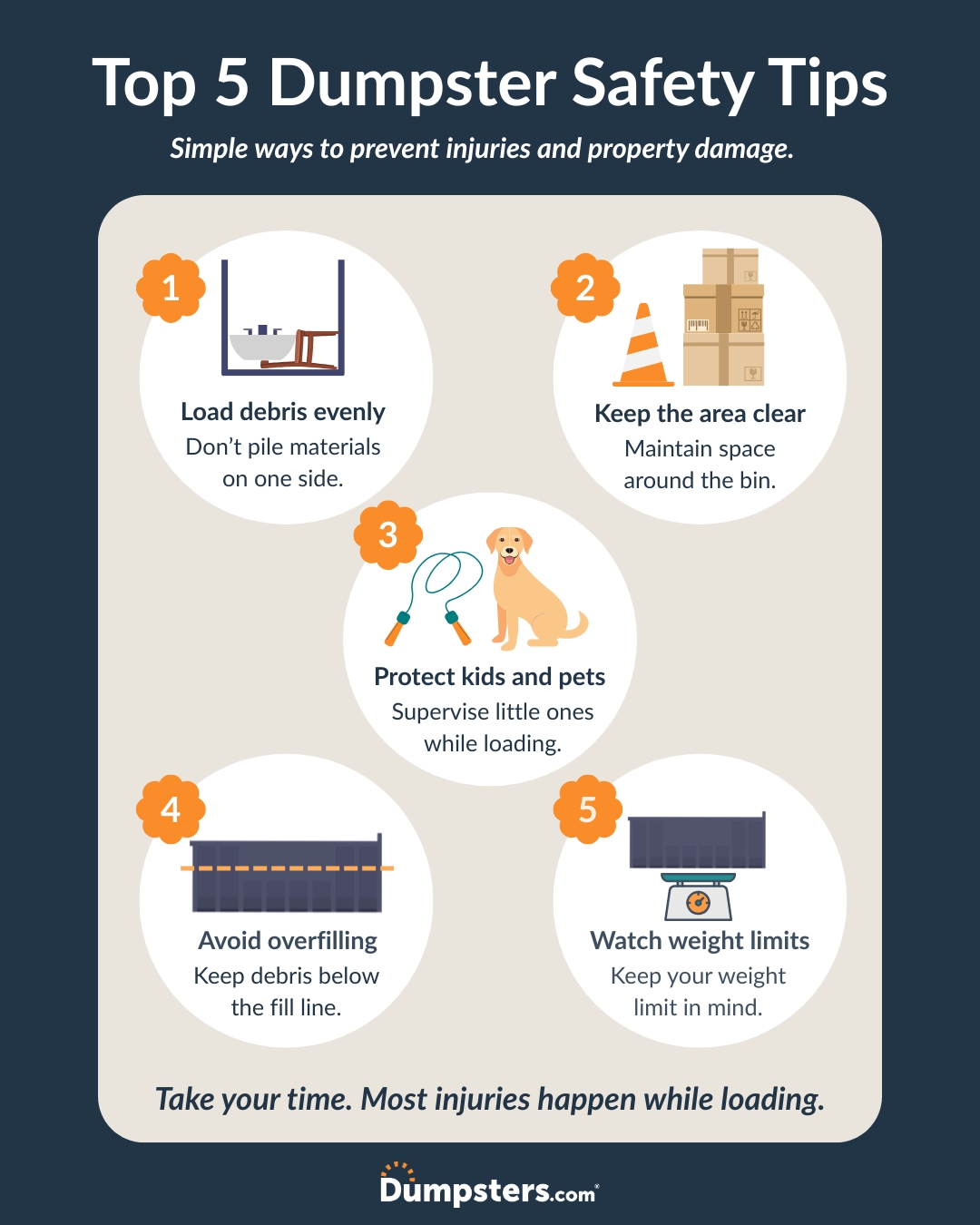
View 5 More Dumpster Safety Tips Infographic
Be Aware of Prohibited Items
There are some materials that never go in a roll off dumpster because they can damage the dumpster or landfill, or they need to be processed separately from typical household and construction debris. Common prohibited items include:
Car batteries
Tires
Railroad ties
Hot water tanks
Inks and resins
Paint and lacquers
Household cleaners
Hazardous waste
Keep in mind that waste disposal rules vary by location. Some areas restrict more items from dumpsters and landfills than others. Always check with your local regulations before tossing debris.
If you toss prohibited items in your dumpster, you risk paying a trip fee because our driver can’t take your dumpster to the landfill. For certain restricted items, you may have to pay a disposal fee of $25 to $200 per item if they require extra processing at the landfill. You could also be subject to fines or liability issues.
Pro Tip: Need to Get Rid of Prohibited Items?
Check with your local municipality to find designated hazardous waste facilities in your area. In some locations, local authorities designate a specific date when hazardous and prohibited items can be tossed safely.
How to Maximize Space in Your Dumpster
Maximizing space is important to make sure you fit the most debris in your dumpster without going over your container’s fill line.
7 Dumpster Loading Tips to Make Every Inch Count
1. Load heaviest items first
Always start by loading heavy materials at the bottom of your dumpster. This creates a solid foundation for a secure load.
2. Break down large items when possible
Disassembling bulky items allows you to fit more in your dumpster by reducing wasted space between debris.
3. Distribute weight evenly across the container
Spread heavy materials evenly throughout the bin to improve stability and keep your debris weight balanced for a safe pickup.
4. Pack systematically rather than randomly
Material sorting lets you place large, heavy items first and fill gaps with lighter debris for a balanced, organized load.
5. Plan your loading approach before you start
Having a plan before loading ensures each debris type goes in the right place to avoid wasting space.
6. Use vertical space effectively
Stack items carefully to make the most of vertical space, fitting more debris safely while keeping the load stable and within fill limits.
7. Fill hollow items with smaller debris
Use all space available in your dumpster by fitting small debris into hollow items, like boxes or empty appliances.
Material-Specific Loading Strategies
Heavy Materials
Place concrete, brick and dirt at the bottom of the dumpster to create a stable base and evenly distribute weight. Calculate the weight of your debris beforehand to avoid going over your dumpster’s weight limit.
Construction Debris
Stack lumber, drywall and roofing materials in layers, breaking down large pieces to maximize space and maintain balance.
Yard Waste
Stack branches and yard debris tightly, layering leaves and smaller materials on top to fill gaps without crushing lighter items.
Household Items
Place sofas, dressers, and appliances with the heaviest pieces on the bottom, nesting hollow items like chairs or bins to maximize space.
Understanding Dumpster Load Limits
There are two important limits to be aware of when loading your bin: the dumpster weight limit and the fill line.
Is Your Dumpster Overfilled? Here’s How to Tell
An overfilled dumpster can happen in two ways:
1. You fill past the dumpster’s volume. This happens when debris sticks out above the fill line. Each dumpster has a line marked on the inside of the container to indicate where you should stop loading debris. If debris is above the fill line, we won't be able to pick up your dumpster, resulting in a trip fee.
2. You fill past the dumpster’s weight limit. This happens when the debris is heavier than the amount of weight the dumpster can safely transport. Each dumpster has a weight limit, measured in tons. If you go over your bin's weight limit, you'll receive a per-ton overage fee only for the amount you went over.
Your dumpster needs to have a level load below the fill line for safe transport and to avoid extra disposal fees. If you go over the fill line, our driver won’t be able to pick up your dumpster, resulting in a trip fee, and you may need to pay for an additional dumpster. If you go over the weight limit, you’ll receive a per-ton overage fee.
How to Avoid Overage and Disposal Fees
The best way to avoid overage and disposal fees is to understand:
- Dumpster capacity
- Dumpster weight limit
- Debris type and amount
- Debris weight
You’ll receive your dumpster capacity and weight limit information when you order. To calculate your debris weight, contact our team or use our dumpster weight calculators for specific debris types. You can also use the following weight estimates to gauge how much your materials weigh:
Concrete
~150 pounds per cubic foot
Brick
~120 pounds per cubic foot
Dirt/soil
~100–120 pounds per cubic foot (depends on moisture)
Lumber
~35–50 pounds per cubic foot
Drywall
~50–60 pounds for a 4-by-8-foot sheet
Yard waste
10–30 pounds per cubic foot, depending on moisture
Appliances/furniture
Check manuals or manufacturer specs if possible
Which Costs More: Paying Overage Fees or Renting Another Dumpster?
Depending on your location and project size, renting a second dumpster may be more cost-effective than paying overage or trip fees.
- If you go over your dumpster’s weight limit, you’ll pay $50 to $250 per ton over your set limit.
- If you overfill your dumpster, you’ll face a trip fee, typically $195 to $350, and then need to rent an additional dumpster to dispose of the remaining debris.
The average cost of a roll off dumpster is $663, with typical prices ranging from $286 to $1,538 depending on size and location.
Additional considerations to help you decide:
- Estimate your load beforehand: Check the weight and volume of your debris to determine if one dumpster is sufficient.
- Know the type of debris: Heavy materials (concrete, brick, dirt) can hit weight limits quickly, even if your dumpster isn’t full.
- Plan for multiple pickups: Large projects may benefit from scheduling multiple smaller dumpsters rather than risking overage fees.
- Compare rental vs. overage fees: Often, the upfront cost of a second dumpster is cheaper and less stressful than surprise fees.
When your debris won’t fit or is far heavier than your weight limit, renting a second dumpster is usually the cheaper option. But if you’re only a little over the weight limit, paying the pro-rated overage fee typically costs less than renting another dumpster.
Should You Rent Multiple Dumpsters for Large Projects?
Large construction, demolition or renovation projects often generate more debris than a single dumpster can hold. Multiple containers help keep your work site organized and prevent downtime while waiting for swaps.
When to Consider Multiple Dumpsters
You may need more than one dumpster if:
You’re working on multi-phase projects, such as full-home remodels, multi-unit cleanouts or commercial renovations.
You’re tossing different types of materials that shouldn’t be mixed, like concrete, roofing and household junk.
You have a tight timeline, and delays for a pickup could stall progress.
Should I Use Multiple Dumpsters or One 40 Yard Dumpster?
Choosing between multiple smaller dumpsters or one large container depends on your project’s scope, debris type and timeline.
Cost-Benefit Comparison: Multiple Containers vs. One Large Dumpster
Factor | Multiple Containers | Single Large Container |
|---|---|---|
Average Cost | Two 20 yard dumpsters: $800–$1,200 total | One 40 yard dumpster: $600–$800 |
Flexibility | High — allows material separation and placement in multiple areas | Moderate — one central location for all debris |
Efficiency | Continuous loading — one fills while another is swapped | May require downtime during haul or swap |
Weight Management | Easier to stay under limits and avoid overage fees | Higher risk of exceeding weight limits ($50–$250/ton) |
Site Space Needed | May require more on-site space for multiple units | Takes up less space overall |
Coordination Effort | More scheduling for deliveries and pickups | Simple — only one delivery and pickup |
Best For | Large or multi-phase projects, heavy or mixed debris, long timelines | Smaller or single-phase projects, light or bulky debris, limited space |
Example Scenario | Full home renovation or commercial remodel | Whole-house cleanout or large landscaping job |
Multiple dumpsters are typically best for large or multi-phase projects, heavy or mixed debris disposal and long timelines. One large container works better for smaller or single-phase projects, light or bulky debris and limited space.
Tips to Coordinate Deliveries and Pickups for Multiple Dumpsters
Plan dumpster deliveries around your project timeline to avoid downtime and overflow by following these simple tips:
Schedule early
Have the first dumpster delivered a day before work begins.
Time pickups smartly
Arrange empty-and-return service when containers are nearly full or between project phases.
Stay flexible
With Dumpsters.com, you have the ability to change schedule without penalty and schedule a pickup online via our Service Dashboard.
Leave delivery areas clear
Make sure the drop-off area is accessible for the whole delivery and pickup day, since it can come at any time.
Keep your crew informed
Let workers know when swaps or deliveries are scheduled to avoid delays.
How to Keep Track of Your Loading Progress
Stay organized and avoid overfilling by monitoring your dumpster as you go.
Do quick visual checks
Scan the dumpster regularly to see how full it is and identify uneven stacking.
Estimate weight by material
Keep in mind heavy items (concrete, brick, dirt) versus lighter debris (yard waste, furniture) to avoid exceeding weight limits.
Step back and reassess
Pause periodically to plan the next layers or reorganize items for maximum space efficiency.
Take photos
Snap progress photos to track fill levels, document your load or resolve any questions.
Stay consistent
Checking frequently prevents surprises and helps you make the most of your container.
Tips for Managing Your Home Renovation Debris
Keep your renovation project organized and avoid extra fees by staying on top of what goes into your dumpster.
- Monitor what’s tossed: Check the dumpster regularly to ensure only approved materials — like wood, drywall and fixtures — are being disposed of.
- Keep prohibited items out: Remind everyone that paint, batteries, electronics and hazardous materials need separate disposal.
- Post a quick guide: Tape a short “what goes in / what stays out” list near the dumpster to prevent mistakes.
- Get everyone on board: Make sure family members, contractors and helpers know the rules before cleanup starts.
- Track capacity: During room-by-room cleanouts, check fill levels daily and schedule a pickup before the container overflows.
- Stay organized: Separate recycling, bulky furniture and renovation waste for smoother loading and easier disposal.
Local Regulations and Compliance: Understanding Local Waste Disposal Rules
When renting and loading a dumpster, it’s important to understand local regulations, as rules vary by municipality and affect how you dispose of materials and possible disposal fees.
Common Municipal Regulations
Weight and Size Limits
Cities may set maximum weight or volume limits for dumpsters placed on public streets.
Placement Rules
Some areas require permits when placing a dumpster on the curb, sidewalk or road.
Prohibited Items
Certain materials — like hazardous waste, chemicals, tires, electronics or appliances containing Freon — are often banned from dumpsters.
Permit requirements:
- Many municipalities require permits for dumpsters placed in public areas or for certain types of debris, such as construction materials, concrete or roofing shingles.
- Permits often specify how long the dumpster can remain in place and where it can be located.
Impact on disposal fees:
- Local restrictions and prohibited items can lead to extra fees if violated.
- If you toss prohibited items, our driver can’t pick up your dumpster, so checking municipal rules beforehand can prevent unexpected costs.
Load Smart, Stay Safe and Save Money
Efficient dumpster loading isn’t just about throwing debris in a bin — it’s about planning, organization and safety. By following the techniques outlined in this guide, you can:
Maximize space
Stacking strategically, breaking down large items and filling hollow spaces.
Stay within weight and fill limits
To avoid overage and disposal fees.
Protect yourself and your crew
By using proper loading techniques, personal protective equipment and awareness of sharp or heavy items.
Manage complex projects
With multiple dumpsters, coordinated pickups and careful tracking of renovation debris.
Comply with local regulations
By understanding prohibited items, permit requirements and municipal disposal rules.
Remember, preparation is key. Plan your loading sequence, track your progress and reach out to our team with any questions to keep your project running smoothly, efficiently and safely. A little effort upfront saves time, money and stress — and helps you get the most out of your dumpster rental.
More Dumpster Rental Resources
How to Rent a Dumpster
From start to finish, learn how to rent a dumpster the easy way with Dumpsters.com.
Weight Limits
Understand dumpster weight limits so you can pick the right size for your debris effortlessly and steer clear of any extra fees.
Prohibited Items
Check our list of prohibited items to protect yourself, your dumpster and avoid unexpected fees.
Glossary Term Index
Dumpster | Dumpster Delivery | Dumpster Drop-Off | Dumpster Fee
Dumpster Pickup | Dumpster Rental Period | Fill Line | Open Top Dumpster
Prohibited Items | Restricted Materials | Roll Off Dumpster